

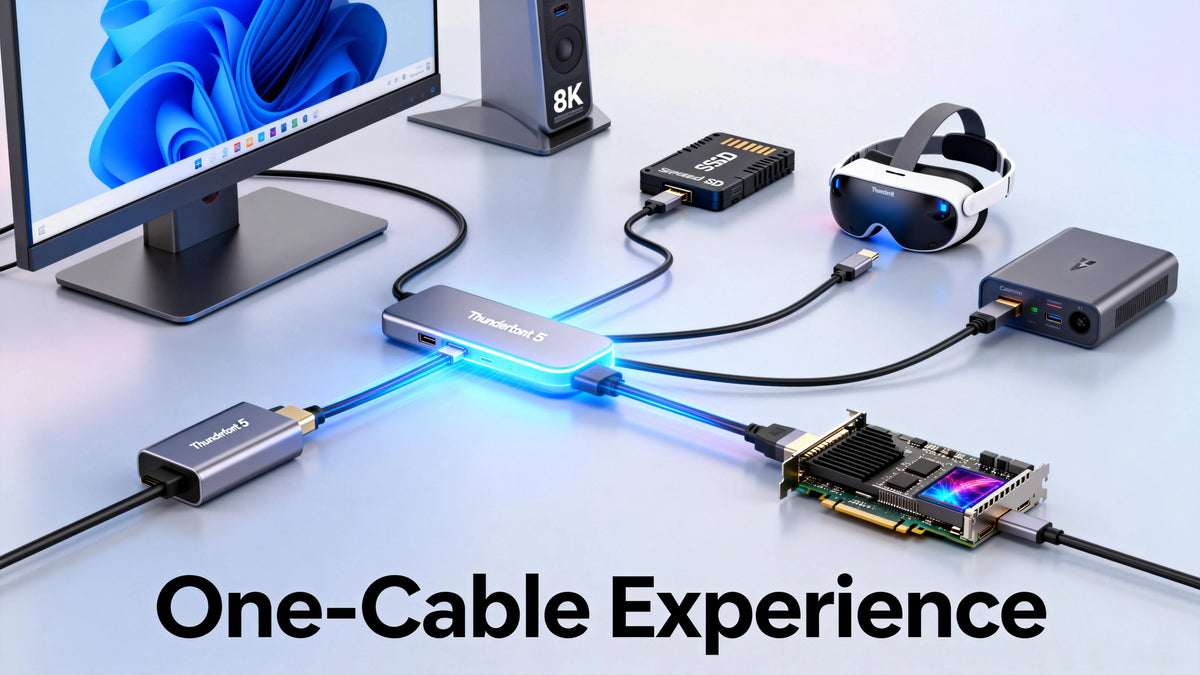
How long does it take to transfer an 80 GB 8K movie to a 4 TB SSD? Thunderbolt 3 takes about 40 seconds, Thunderbolt 4 about 30 seconds, and the upcoming Thunderbolt 5 would theoretically only take about 16 seconds.

Interface development: From dedicated connection to universal solution
The development of the Thunderbolt interface is a story of technological evolution – from niche professional use to widespread application. This technology, jointly developed by Intel and Apple, originally used the Mini DisplayPort form factor and went through the Thunderbolt 1 and 2 generations.
The major breakthrough for Thunderbolt 3 was the introduction of the then-emerging USB-C interface. This seemingly simple change actually led to the "democratization" of Thunderbolt, as the technology became compatible with the increasingly popular USB-C ecosystem.
Thunderbolt 4, released in 2020, focused more on standardization and feature improvement than simply increasing speed. It established minimum performance standards, improved security, and broader compatibility, so the "Thunderbolt 4" logo guarantees a consistent, high-quality user experience.
Thunderbolt 5 is the next performance level, doubling the bandwidth compared to Thunderbolt 4, widening the gap to other interface technologies and solidifying Thunderbolt's leading position in the high-end connectivity sector.
Key parameter comparison: Practical meaning behind the numbers

The differences between Thunderbolt 3, 4, and 5 are most apparent in their bandwidth parameters. Thunderbolt 3 offers a total bandwidth of 40 Gbps, with video and data sharing this resource; Thunderbolt 4 maintains the same total bandwidth but improves actual usability through optimized allocation.
Thunderbolt 5 brings a significant leap in bandwidth, with up to 80 Gbps expected bidirectionally and even up to 120 Gbps unidirectionally in certain modes, designed for ultra-high-resolution displays and high-speed storage.
Video support capabilities are a key concern for professional users. Thunderbolt 3 supports a single 8K display or two 4K displays; Thunderbolt 4 improves multi-display support; Thunderbolt 5 takes this capability to a new level, expected to support multiple 8K displays or a single 16K display. Power delivery is also a crucial factor for everyday use. Thunderbolt 3 and 4 support up to 100W of power delivery, sufficient for most laptops; Thunderbolt 5 is expected to further increase power delivery, potentially delivering even higher performance.
Comparison with USB standards: Clear technological hierarchy

One of the best ways to understand Thunderbolt's performance is to compare it to the widely used USB standard. When Thunderbolt 3 was released, its performance was four times faster than the contemporary USB 3.2 Gen 2 (10 Gbps).
When Thunderbolt 4 was released, USB4 was just getting started. Interestingly, USB4 is actually based on the same technological foundation as Thunderbolt 3, making Thunderbolt 4 and USB4 closely related in terms of their underlying technology. However, Thunderbolt 4 offers a stricter minimum performance guarantee.
Technologically, the following correspondence relationship can be derived:
Thunderbolt 3 ≈ Technological predecessor of USB4 40 Gbps
Thunderbolt 4 = Enhanced USB4 version with stricter performance requirements
Thunderbolt 5 = Next generation with high-performance standard, significantly beyond USB4.
This classification helps consumers understand that Thunderbolt interfaces will always remain at the forefront of consumer connectivity, offering performance and functionality that surpass current USB standards.
Practical application scenarios: Which users should choose which generation?

When choosing between the different Thunderbolt generations, users should base their decision on actual requirements, not just on the latest model. Content creators and professional users, such as video editors and 3D animators, have the highest demands for transfer speed and multi-monitor support.
For users who primarily work with 4K/8K video footage or large design files, Thunderbolt 5 is the best choice, as its ultra-high bandwidth can significantly reduce file transfer and rendering times. Users already using Thunderbolt 4 whose workflow is smooth don't need to upgrade urgently.
Business and professional users, such as financial analysts or software developers, often need to connect multiple monitors and high-performance peripherals. Thunderbolt 4 currently fully meets these requirements, offering stable multi-monitor support and sufficient bandwidth for docking station connections.
For this group: If Thunderbolt 3 devices are still working perfectly, an upgrade to Thunderbolt 4 is not urgently needed unless they require enhanced security features or more stable multi-monitor support. They can wait until Thunderbolt 5 is more mature before considering an upgrade.
Average users and students primarily need to connect external monitors, transfer files, and edit everyday files. Thunderbolt 3 is perfectly adequate for these tasks and delivers significantly higher transfer speeds than standard USB interfaces.
Future outlook: Thunderbolt 5 and the development trends of connectivity technology

The introduction of Thunderbolt 5 not only signifies increased performance but also signals the general evolution of connectivity technology. With the growing popularity of 8K content and virtual reality applications, ultra-high-bandwidth interfaces will move from the professional sector to the mass market.
It's worth noting that Thunderbolt is driving the standardization of interfaces. USB4 is based on Thunderbolt 3, and future USB standards will likely continue to integrate Thunderbolt's advanced features, resulting in a unified, high-performance, universal interface standard.
From a product ecosystem perspective, the introduction of Thunderbolt 5 will drive the development of a new generation of peripherals. Ultra-high-resolution monitors, high-speed storage devices, and professional video capture cards will benefit from the high bandwidth offered by Thunderbolt 5, achieving even greater performance.
For consumers, this means that in the coming years more well-designed, high-performance single-cable solutions will be available that truly deliver the simple and efficient "single-cable" experience.
Split:
How TESmart KVM Hotkeys Work: Complete Explanation for Efficient Multi-Computer Control
Thunderbolt vs. USB-C (DP-ALT): The Ultimate Guide to Choosing the Right KVM Interface