

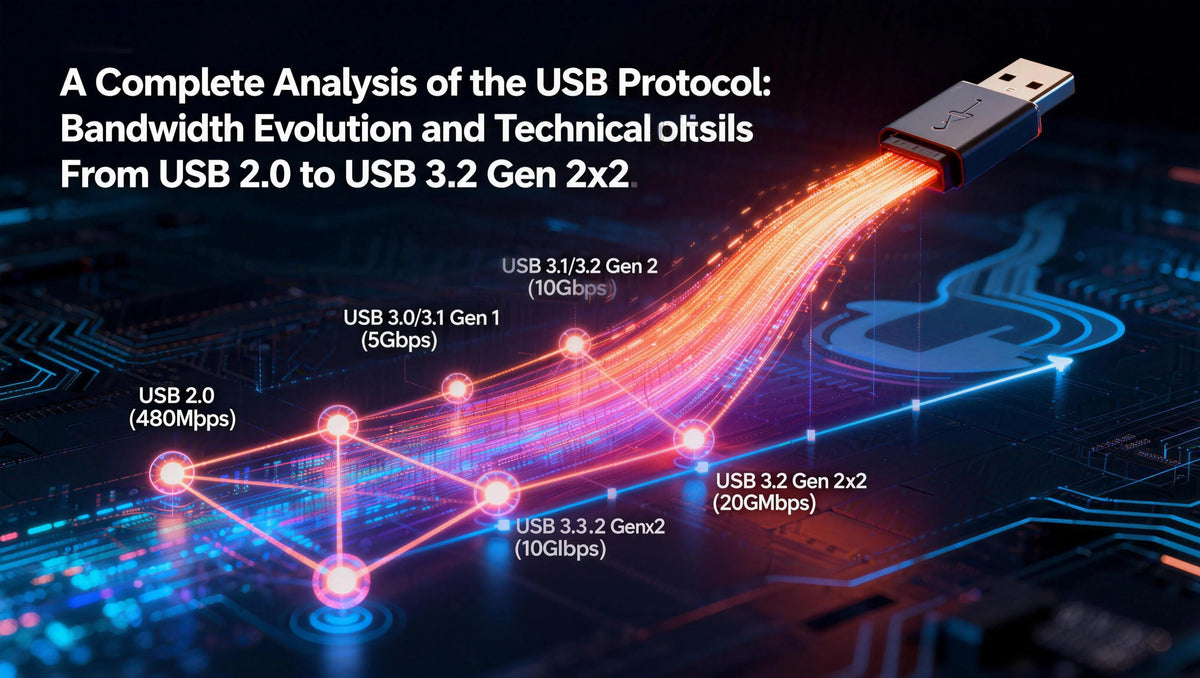
When transferring a 5GB HD movie from your computer to an external hard drive, USB 2.0 takes about 13 minutes, USB 3.2 Gen 1 about 1 minute, while USB 3.2 Gen 2x2 only takes a short 17 seconds.

The evolution of protocol designations: From a clear system to confusion
The history of USB protocol designations is a development from simple and understandable to complex and confusing. Early designations were intuitive and easy to understand: USB 1.0, USB 2.0, and USB 3.0 clearly represented technological generational shifts.

In 2013, the USB-IF organization began introducing a confusing new naming scheme. USB 3.0 was renamed USB 3.1 Gen 1, while the actual USB 3.1 was designated USB 3.1 Gen 2.
The renaming in 2019 further complicated matters. USB 3.1 Gen 1 became USB 3.2 Gen 1, USB 3.1 Gen 2 became USB 3.2 Gen 2, and the new multi-channel technology USB 3.2 Gen 2x2 was also introduced. While technically correct, this naming system is extremely user-unfriendly for the average consumer.
Understanding this naming system is fundamental to properly classifying USB technology. Below, we analyze the actual performance of each protocol generation in detail.
USB 2.0: The lasting importance of a classic standard
USB 2.0 was released in 2000 and is the longest-lasting and most widely used USB standard. It uses half-duplex communication with a theoretical bandwidth of 480 Mbps (approx. 60 MB/s), although the actual transfer speed usually only reaches 30–40 MB/s.

This performance difference arises from protocol overhead and practical implementation limitations. USB 2.0 uses a 4-pin connector (VBUS, D+, D-, GND), offers excellent compatibility, and remains the preferred interface for many low-bandwidth devices such as keyboards, mice, and basic printers.
Despite its limited performance, USB 2.0's long lifespan and broad compatibility make it one of the most successful interface standards in computer history. Its truly revolutionary contribution was unifying the then-chaotic ecosystem of peripheral interfaces.
Even today, many devices still feature USB 2.0 ports for basic peripherals, while high-speed ports remain reserved for storage devices and bandwidth-intensive equipment. This port allocation remains common on modern computers.
USB 3.2 Gen 1: The beginning of the high-speed USB era
USB 3.2 Gen 1 (originally USB 3.0) marked the beginning of the high-speed USB era and was released in 2008. It offered a theoretical bandwidth of 5 Gbps (approximately 625 MB/s) – more than ten times that of USB 2.0.
This protocol generation introduced full-duplex communication and added five additional contacts (for a total of 9 pins), enabling simultaneous sending and receiving of data. Actual transfer speeds are typically 400–500 MB/s and are sufficient for most external storage devices.
USB 3.2 Gen 1 also introduced more efficient power management, delivering a maximum current of 900mA (180% of USB 2.0), thus significantly improving power supply for peripherals. The blue connector color became the intuitive identifying feature for high-speed USB.
Although newer standards now offer higher performance, USB 3.2 Gen 1 remains the most widespread “high-speed USB” implementation on the market.It offers a balanced ratio between performance, cost and compatibility, making it an economical choice for many consumer devices.
USB 3.2 Gen 2: A significant performance leap

USB 3.2 Gen 2 (originally USB 3.1) was released in 2013 and increased the theoretical bandwidth to 10 Gbps (approx. 1250 MB/s), thus doubling it again. Actual transfer rates reach 800–1000 MB/s and are therefore suitable for 4K video editing and large file transfers.
While maintaining backward compatibility, this protocol generation also optimized data encoding, reducing encoding loss from 20% in USB 3.2 Gen 1 to approximately 3%. This makes data transmission more efficient and brings it closer to the theoretical maximum.
USB 3.2 Gen 2 also supports the USB Power Delivery (PD) standard and can provide up to 100W of power, fundamentally changing charging and data transfer experiences. A single USB-C port can therefore simultaneously charge a laptop, transfer data, and connect a monitor.
With the increasing prevalence of the USB-C port, USB 3.2 Gen 2 is becoming a standard feature in mid-range and high-end devices, offering a good balance between performance and cost.
USB 3.2 Gen 2x2: The breakthrough of multi-channel technology

USB 3.2 Gen 2x2 is the most advanced version of the USB 3.2 specification and was released in 2019. Through dual-channel technology, it achieves a theoretical bandwidth of 20 Gbps (approximately 2500 MB/s), representing the pinnacle of current USB protocol performance.
This performance increase is not achieved by increasing the speed of a single channel, but by simultaneously using two 10Gbps channels. Both the host and the peripheral device must support this standard for this to work.
In practice, USB 3.2 Gen 2x2 achieves transfer rates of 1500–2000 MB/s, approaching the performance of entry-level NVMe SSDs. This allows external storage devices to truly unlock the potential of modern high-speed SSDs and meet the demands of professional content creation.
Currently, USB 3.2 Gen 2x2 is primarily used in high-end external storage devices and professional docking stations and is not yet a widespread standard in the consumer market. This standard is usually identifiable by the "20Gbps" or "SuperSpeed+ 20Gbps" label on the USB-C port.
Technology comparison and buying advice

When buying USB devices, you shouldn't rely solely on the color or shape of the connector to determine its speed. A USB-C port may only support USB 2.0, while some USB-A ports can support USB 3.2 Gen 2. The most reliable method is to check the device's exact protocol specifications.
For most users, USB 3.2 Gen 1 is sufficient for everyday use. Users who frequently transfer large files should consider USB 3.2 Gen 2. USB 3.2 Gen 2x2 is primarily necessary for professional content creators and users with extremely high performance requirements.
Future outlook: USB4 and the integration of Thunderbolt

The development of the USB protocol is not yet complete. The USB4 standard, released in 2019, integrates Thunderbolt 3 technology, offers a maximum bandwidth of 40 Gbps, and introduces smarter mechanisms for bandwidth allocation.
USB4 is based on the Thunderbolt 3 protocol, but it doesn't require all implementations to actually achieve 40Gbps. This could lead to USB4 devices with varying performance levels being released, further confusing consumers.
The central trend in future USB technologies lies in functional integration: a single interface simultaneously handles high-speed data transfer, high-resolution video output, and powerful charging. This "single-cable" experience is increasingly spreading from the professional high-end market to the mainstream consumer sector.
With the increasing adoption of USB4 and Thunderbolt 4 standards, consumers will face more complex, yet more powerful, interface choices in the coming years. Understanding the fundamental differences between various USB protocols will be crucial for making informed purchasing decisions.
Split:
**How to Connect PS5 or Nintendo Switch to Apple Studio Display: The Ideal Multi-Device Desk Setup Solution**
MacBook Multi-Monitor Setup Guide: How to Build an Efficient Dual-Monitor Workstation