

Table of contents
- Introduction
- What users actually want to solve
- Why long HDMI cables aren't always the cleanest solution
- Why KVM extension is more than just HDMI extension
- When a 120m extension makes sense
- HDMI cable vs. HDMI KVM extender
- Where TESmart HKE12MM-L25 is used effectively
- How to choose between the two solutions
- FAQ
- Conclusion
Introduction
If a display is located only a few meters away from a computer, an HDMI cable is usually the simplest solution.
However, the decision changes as soon as the distance reaches 30 m, 60 m, or even 120 m. From this point on, it's no longer just about whether the signal reaches the display. The real question is whether the system remains stable, easy to install, and practical to use.
This is precisely the practical difference between a long HDMI cable and an HDMI KVM extender.
What users actually want to solve
Users typically consider HDMI extension over longer distances for three reasons.
The computer should remain in a rack or server room. The display is located far from the source. Or the operator needs to control the source system from another location.
The third point in particular is often overlooked.
A long HDMI cable can transmit video signals across a room, but not keyboard and mouse control. If the source computer is located far away, users often need a separate USB extender, additional cables, or other control solutions. This makes the system more difficult to install and more complicated to maintain.
An HDMI KVM extender combines video and control in a single system.
Why long HDMI cables aren't always the cleanest solution
Long HDMI cables can work in some installations, but have practical limitations.
They are often thicker and more difficult to install than network cables. Routing them through walls, ceilings, or cable ducts can be problematic. Long cable runs are also more sensitive to cable quality, connector stress, and installation conditions.
Replacing a faulty long HDMI cable can be particularly time-consuming if the cable has already been installed in a finished room. More importantly, HDMI alone does not solve the problem of keyboard and mouse extension cables.
For a temporary setup, a long HDMI cable might suffice. However, for conference rooms, control rooms, production environments, or signage networks, a more structured solution is usually required.
CAT5e/6 cabling is easier to install and more familiar to many AV and IT installers. It also allows for a transmitter/receiver architecture, instead of relying on a single long direct cable.
Why KVM extension is more than just HDMI extension
The term "HDMI extender" usually means pure video extension.
"HDMI KVM extender" means video plus keyboard and mouse control.
This difference is crucial when the computer is not directly next to the operator. A receiver near the display or workstation enables local access to the remote computer, allowing users to work with the system without having to be physically present at the source device.
In environments with multiple sources, KVM extensions become even more important.Operators may need to switch between multiple PCs, manage different displays, or monitor multiple systems simultaneously. A simple HDMI extension path is not designed for this level of operation.
When a 120m extension makes sense
A range of 120 m not only serves to achieve the greatest possible distance, but also creates an additional safety margin for installations.
Cable runs are rarely straight. A display that is physically only 40 m away can require a significantly longer cable run due to ceilings, walls, server racks, and cable trays. Additional range reserve reduces the risk of planning a system too close to its maximum limit.
This is particularly relevant in environments where source devices and displays are deliberately separated.
Typical examples include conference rooms with central equipment cabinets, control rooms with operator workstations away from the computers, digital signage networks in retail or campus areas, training rooms with multiple source locations, and industrial environments where PCs should remain separate from the operator area.
In such cases, CAT5e/6-based signal extension enables a cleaner and more flexible installation.
HDMI cable vs. HDMI KVM extender
| factor | Long HDMI cable | HDMI KVM extender over CAT5e/6 |
|---|---|---|
| Optimal application area | Short or simple video-only connection | Video and control extension over long distances |
| Keyboard and mouse control | Requires a separate USB solution | Integrated into the KVM extension workflow |
| Cable laying | Often difficult over long distances | Uses easier-to-install CAT5e/6 cables |
| Expandability | Mostly a fixed 1-to-1 connection | More flexible transmitter/receiver architecture possible |
| Installation flexibility | Highly dependent on cable length and routing path | Better suited for racks, walls, ceilings and structured cabling. |
| Ease of use | Only video is enhanced; controls remain separate. | Video and controls are available directly at the receiver. |
Where TESmart HKE12MM-L25 is used effectively
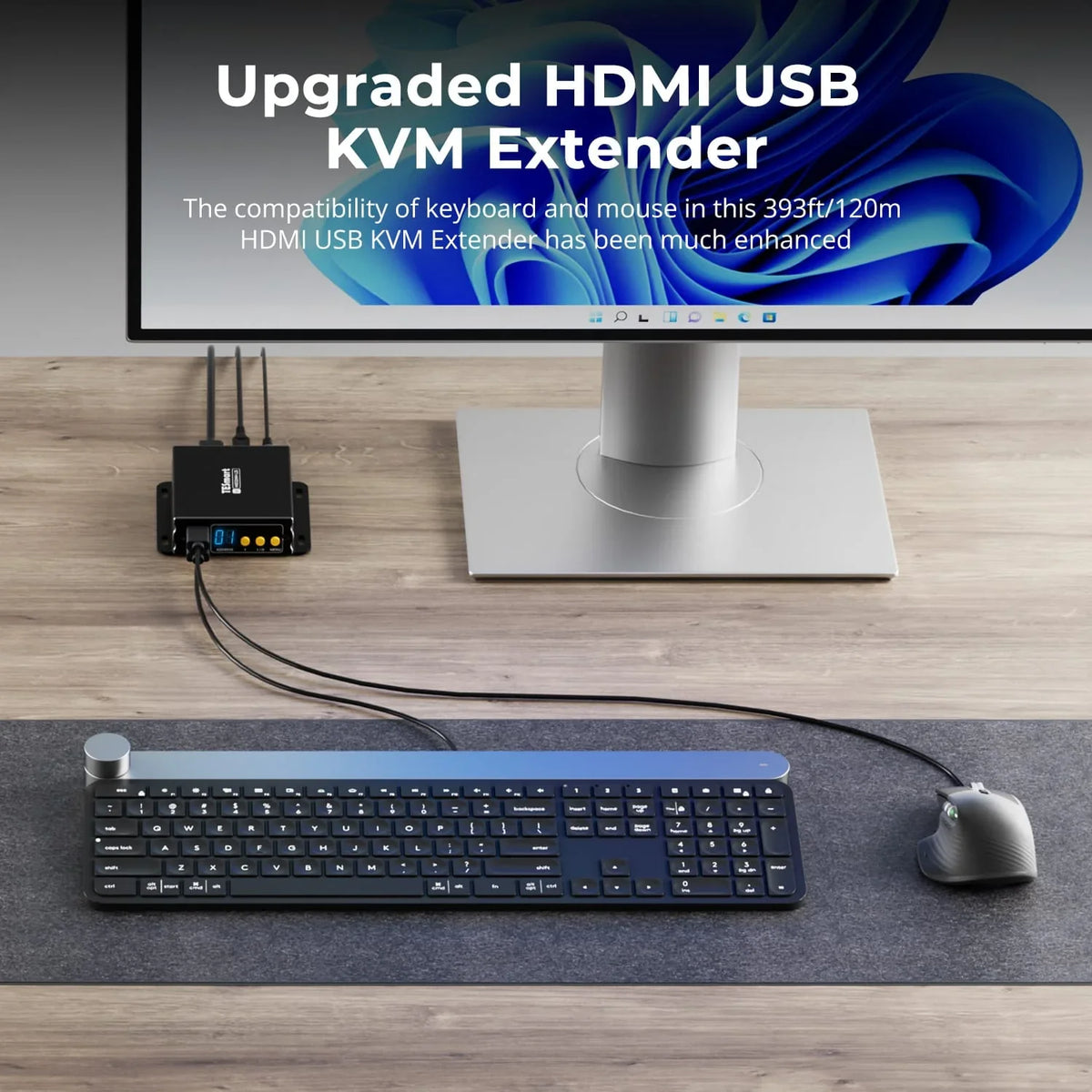
The TESmart HKE12MM-L25 was developed for users who 1080P@60Hz-HDMI-KVM-Erweiterung bis up to 120 m via CAT5e/6 cable need.
Instead of combining a long HDMI cable with separate USB control, the system integrates HDMI extension as well as keyboard and mouse control into a single solution. This makes it particularly suitable for control stations, server rooms, conference environments, and multi-PC setups where users need to actively work with remote sources.
The product also supports PoE and DC 12V power supply. In real-world installations, this offers added flexibility in the placement of transmitter and receiver units. If local power supply is difficult, PoE can reduce the number of separate power supplies, depending on the system design.
For more demanding installations, HKE12MM-L25 supports Single-screen and quad-screen modes. In quad-screen mode, it is possible Keyboard and mouse cross-control the control of multiple visible systems from a single working position.
The system also supports up to 32 transmitters and 32 receivers and is therefore suitable for AV-KVM environments that need to be expanded beyond a simple 1-to-1 connection.
How to choose between the two solutions
A long HDMI cable is often sufficient if the distance is short, only video is needed, the setup is temporary, the computer remains physically accessible, and only one source is connected to a display.
An HDMI KVM extender is the better choice if the source and operator are located far apart, keyboard and mouse control is required, the installation includes walls or server racks, multiple sources or receivers are to be added later, and clean, structured cabling is desired.
The difference, therefore, lies not only in the distance. It is the difference between a simple cable connection and a complete operating system for work environments.
FAQ
Can I simply use a very long HDMI cable instead of an extender?
Yes, this is possible in some simple video setups. However, a long HDMI cable doesn't offer keyboard and mouse control and can be more difficult to route and maintain over long installation distances.
Does an HDMI KVM extender require special network infrastructure?
CAT5e/6 cable is used as the transmission medium, but the exact requirements depend on the extender architecture. Network planning and IP address allocation become more important in scalable systems.
Why is 120 m² useful if my room is smaller?
The physical distance between two devices is often shorter than the actual cable run. Cables run through ceilings, walls, racks, and cable trays. Additional cable length provides greater planning certainty.
What does KVM add compared to simply extending HDMI?
KVM also extends keyboard and mouse control, allowing users to operate the remote computer directly from the receiver, instead of just seeing its HDMI output.
Can this type of extender support multiple sources?
Some basic extenders are fixed 1-to-1 systems. In contrast, the HKE12MM-L25 was designed for scalable installations and supports up to 32 transmitters and 32 receivers.
Conclusion
A long HDMI cable simply extends a signal. An HDMI KVM extender expands an entire work environment.
For simple display connections over short distances, a single cable may suffice. For room-sized installations up to 120 m — especially when operators require active control — an HDMI KVM extension over CAT5e/6 is usually the significantly more practical architecture.
TESmart HKE12MM-L25 It fits perfectly into this category, as it 1080P@60Hz-HDMI-Verlängerung, keyboard and mouse control, PoE support, quad-screen operation and scalable transmitter/receiver architecture combined in a single AV KVM system.
Split:
Why HDMI KVM extenders over CAT5e/6 make sense in control rooms
Quad-screen cross-control explained: Control multiple PCs without having to switch between workstations