

Table of contents
- Introduction
- Why MST and DisplayLink are often confused in multi-monitor setups
- What is DisplayPort MST?
- What are USB-C MST and DisplayPort Alt Mode?
- What is DisplayLink and how does a DisplayLink dock work?
- MST vs. DisplayLink: Key differences for Mac and Windows users
- Why multiple monitors work differently on a MacBook than in Windows MST setups
- When MST is better for a Windows multi-monitor setup
- When DisplayLink is better for a MacBook multi-monitor setup
- MST-KVM vs. DisplayLink KVM vs. traditional multi-monitor KVM
- How to choose the right multi-monitor KVM switch for Mac and Windows
- How TESmart supports cleaner Mac and Windows desktop setups
- FAQ about MST, DisplayLink and Multi-Monitor KVM Switches
Introduction
Many users are searching for MST vs. DisplayLink, because they want a simple result: to connect a laptop or desktop to two or more external monitors without having to deal with black screens, mirrored displays, missing refresh rates, or unstable switching.
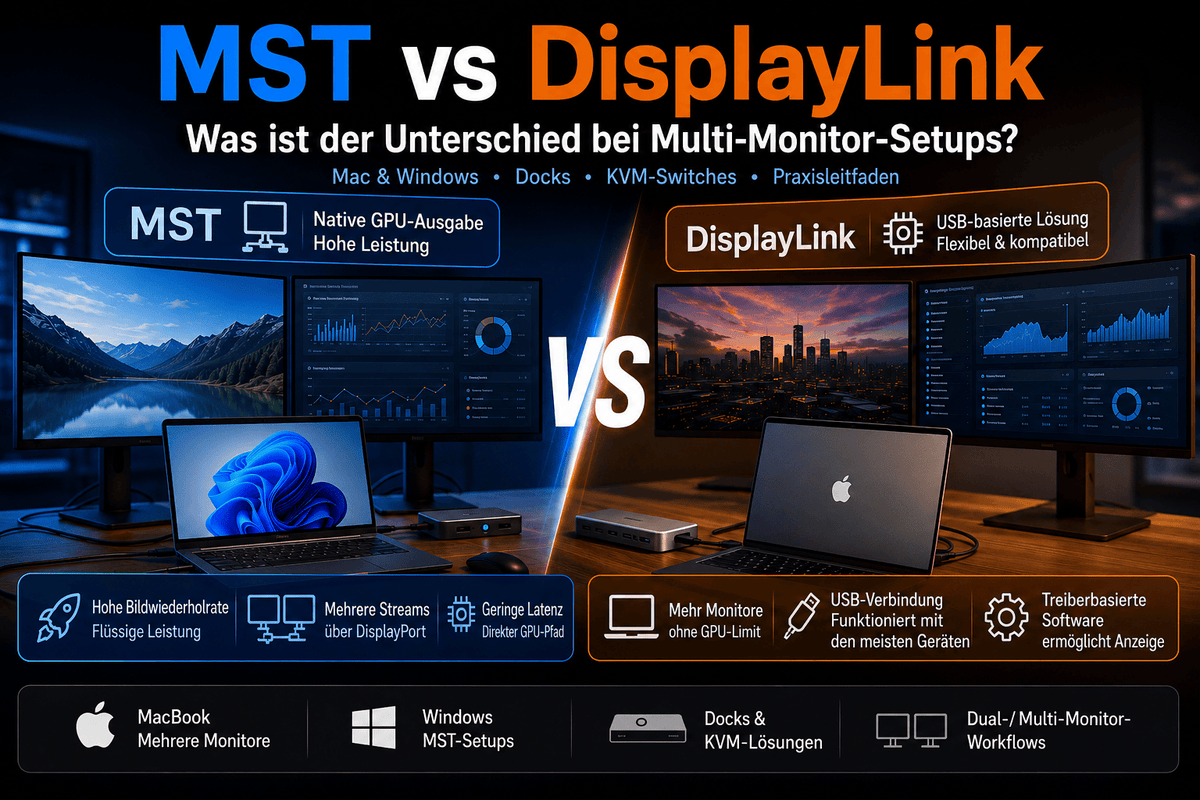
The tricky part is that MST and DisplayLink solve different problems. MST uses the computer's native GPU video pipeline and splits a DisplayPort signal into multiple display streams. DisplayLink generates display output via USB data conversion and relies on software support. Windows MST Setup, a MacBook DisplayLink Dock and a Multi-monitor KVM switch They can all support multiple displays, but they don't all work in the same way.

This guide explains the difference between DisplayLink vs. MST, Why multiple monitors on the MacBook They function differently than Windows dual-monitor setups, and how you decide whether you need one. MST-KVM, a DisplayLink KVM, one KVM docking station or a traditional Dual-monitor KVM switch need.
Why MST and DisplayLink are often confused in multi-monitor setups
MST and DisplayLink are often mentioned together because both can help set up a multi-monitor setup with a laptop. The visible result is similar: one computer controls two or three external displays. However, the underlying technology is very different.
DisplayPort MST It operates within the DisplayPort video standard. It requires a source device that supports MST, a compatible port or hub, and an operating system that can handle independent display streams over this connection.
DisplayLink It works via USB. Instead of sending native GPU video directly via DisplayPort or HDMI, DisplayLink compresses display data, transmits it via USB, and restores it as display output via a DisplayLink chip in a dock, adapter, or KVM docking station.
This distinction is important when users combine MacBooks, Windows laptops, desktops, docking stations, and KVM switches. A setup that, with a Windows laptop, involves... USB-C MST What works well on a MacBook might not deliver the same results. A DisplayLink dock, which allows a MacBook to connect additional monitors, isn't necessarily the best solution for high-refresh-rate gaming or color-critical GPU workloads.

What is DisplayPort MST?
DisplayPort MST, Multi-Stream Transport (MST) allows multiple independent video streams to be transmitted over a single DisplayPort connection. These streams can be output to different monitors via an MST hub, a daisy-chain monitor setup, or a device with MST routing support.
In a typical MST Multi-Monitor Setup A Windows laptop or desktop sends a DisplayPort signal containing multiple display streams. The MST hub or monitor chain separates these streams so that the operating system can recognize two or more external displays.
MST is useful because the display path remains close to the native GPU output. This makes it generally better suited for Windows productivity workstations, engineering workstations, and dual-monitor setups where users value direct GPU rendering, lower latency, and predictable display behavior.
The most important limitation is compatibility. The computer, port, cable, dock or hub, operating system, and monitor chain must all support the required DisplayPort MST behavior. If any part of the chain does not support this, the second monitor may be mirrored, unusable, or limited to a lower resolution.

What are USB-C MST and DisplayPort Alt Mode?
USB-C MST DisplayPort is not a standalone display standard. It usually means that the USB-C port supports DisplayPort video. USB-C DisplayPort Alt Mode transmits and this DisplayPort signal is then split via MST.
Therefore, two USB-C ports that look identical can behave completely differently. One USB-C port might only support charging and USB data transfer. Another might support DisplayPort Alt Mode. A higher-end USB-C or Thunderbolt-enabled port might support higher display bandwidth, but the actual monitor result still depends on the laptop, GPU, operating system, dock, and display chain.
For Windows laptops, USB-C MST can be a convenient way to set up a dual-monitor setup using a hub or dock. For MacBook users, it's more complicated because macOS doesn't handle MST the same way as Windows does in many common setups when it comes to independent extended external displays.
That is one reason why a Mac and Windows desktop setup The connection type should not be the sole factor in the planning process. Before users purchase a dock, adapter, or other device, they should consider the connection type. KVM switch for Mac and PC To select a USB-C port, you need to check what it actually supports.
What is DisplayLink and how does a DisplayLink dock work?
DisplayLink is a USB-based display technology. A DisplayLink dock or adapter uses a DisplayLink chip and driver software to generate one or more external display outputs via USB data.
For users who want to know how to connect multiple monitors to a MacBook, DisplayLink is often considered because it can bypass some native limitations of external displays. MacBook DisplayLink Dock This can help certain MacBook setups to run additional extended displays when a direct MST path is not available or not supported as expected.
The trade-off is that DisplayLink is not the same as native GPU video output. It depends on software, USB bandwidth, system resources, and driver support. For office work, coding, dashboards, documents, and general productivity, it can be a practical solution.For high-refresh gaming, very low latency, HDR-sensitive workflows, or GPU-intensive visual work, native HDMI, DisplayPort, USB-C video, or a traditional KVM path may be more suitable.
Therefore, the question isn't simply whether DisplayLink works. The better question is whether a DisplayLink multi-monitor setup It suits the type of work that needs to be done.
MST vs. DisplayLink: Key differences for Mac and Windows users
The clearest way, MST vs. DisplayLink Comparing them involves looking at how each technology transmits video, what it needs, and where it is best suited.
| Point of comparison | MST | DisplayLink |
|---|---|---|
| Video path | Native DisplayPort video streams from the GPU | USB data converted into display output by a DisplayLink chip |
| Typical area of application | Windows MST Setup, DisplayPort MST Hub, USB-C MST Dock | Multiple monitors on the MacBook, USB docking stations, hybrid KVM docking station setups |
| Driver dependency | It is normally processed via native GPU and operating system display support. | Requires DisplayLink software support |
| MacBook behavior | Often limited for independent extended displays via MST | Commonly used to add external monitors via compatible docks |
| Windows behavior | Usually very suitable if the laptop and dock support MST. | Useful when native display outputs are limited, but less ideal for high-refresh workloads. |
| Best suited for | Native GPU display quality, Windows productivity, DP-based workstations | Dual or triple monitor setups on the MacBook, office productivity, dock-based workflows |
For Windows users, MST is often the cleaner approach if the hardware supports it. For MacBook users, DisplayLink is frequently considered when the target is more than one external monitor and native output paths are limited.
Why multiple monitors work differently on a MacBook than in Windows MST setups
A common long-tail question is: Does MacBook support MST? The practical answer is that MacBook users should not assume that a Windows-like MST setup will provide multiple independent extended monitors.
Many MacBook setups rely on USB-C or Thunderbolt-enabled ports instead of native DisplayPort outputs. Some Mac models have HDMI, but most don't offer a direct, full-fledged DisplayPort connection. If a KVM input only supports DisplayPort, a MacBook typically requires a USB-C to DisplayPort cable, a dock, or some other adapter before it can be connected to that KVM.
This adapter layer is important. Every additional dock or hub introduces another point of negotiation: video mode, bandwidth, HDCP, EDID, USB devices, power supply, and sometimes driver behavior. That's why a MacBook might work directly with a monitor but become unstable when routed through a dock and then a KVM switch.
At multiple monitors on the MacBook The first step is not to select MST or DisplayLink.The first step is to check the Mac model, the number of external displays natively supported, the available ports, and whether the monitors need to be operated via HDMI, DisplayPort, USB-C video, or DisplayLink.
When MST is better for a Windows multi-monitor setup
MST is usually the better way if the computer is a Windows laptop or desktop with reliable DisplayPort output and the goal is to run multiple monitors over native GPU display streams.
A Windows MST Setup is useful if:
The laptop supports USB-C DisplayPort Alt Mode with MST.
The desktop GPU has DisplayPort outputs that support the target resolution and refresh rate.
The monitors or the MST hub support the required display configuration.
The workload benefits from native GPU output, including engineering tools, trading dashboards, development work, and high-resolution productivity.
MST is also better suited when users want to avoid dependence on DisplayLink drivers. In an IT environment, fewer software layers can simplify deployment and troubleshooting.
However, MST isn't magic. If the second monitor isn't recognized, the cause could be bandwidth, a USB-C connection without DisplayPort Alt Mode, a limitation of the MST hub, a cable problem, or different operating system behavior. Dual monitor setup with DisplayPort MST Planning should always be done around the entire signal chain, not just based on the dock label.
When DisplayLink is better for a MacBook multi-monitor setup
DisplayLink is often the better option if the user owns a MacBook and needs more external displays than the native display path can easily support.
A MacBook DisplayLink dock for two monitors It can be useful for office work, software development, document editing, dashboards, email, chat, and browser-based workflows. It can also help mixed Mac and Windows users maintain a consistent desktop structure while switching between devices.
DisplayLink is less suitable if the priority is high refresh rate, very low latency, gaming, HDR-sensitive playback, or workloads where the display needs to behave exactly like a native GPU output. Users who DisplayLink vs. native GPU Those comparing DisplayLink should view it as a convenient USB display path, not as a complete replacement for direct HDMI, DisplayPort, or USB-C video in every scenario.
For MacBook users, the most important advantage lies in its flexibility. DisplayLink dock for MacBook It can enable a multi-monitor desktop without relying on Windows-like MST behavior. The main limitation is that the setup depends on software and USB bandwidth.
MST-KVM vs. DisplayLink KVM vs. traditional multi-monitor KVM
As soon as multiple computers are involved, the question changes. Users no longer simply ask how a single computer can operate multiple monitors. They ask how two computers can share monitors, keyboard, mouse, USB devices, and sometimes audio.
This is where the difference between a dock and a KVM becomes important. A dock extends a single computer. A KVM switches control and display access between multiple computers. KVM docking station It combines parts of both ideas, but users still need to understand how the video signal is generated and switched.
| Setup type | Best suited for | What needs to be checked |
|---|---|---|
| MST-KVM | Windows laptops or desktops with DisplayPort MST or USB-C MST | MST support, GPU output capability, monitor resolution, refresh rate, cable quality |
| DisplayLink KVM | MacBook users who need two or three external displays via a dock-based workflow | DisplayLink driver support, USB bandwidth, PD requirements, number of monitors, workload type |
| Traditional multi-monitor KVM switch | Desktops or laptops that can provide one video output per monitor | Number of computers, number of monitors, HDMI/DP/USB-C inputs, EDID behavior, USB sharing |
A traditional Multi-monitor KVM switch It's often assumed that each computer sends a separate video signal to each monitor. A dual-monitor KVM switch, for example, typically requires two video outputs from each computer. This isn't a bug; it's how the KVM receives each monitor as an independent display path.
How to choose the right multi-monitor KVM switch for Mac and Windows
Before you KVM switch for Mac and PC When selecting, start with the desk structure rather than the product category.
1. Check how many computers need to be switched over.
A two-computer desk has different requirements than a four-computer lab or workstation. A user switching between a MacBook and a Windows PC might only need a KVM switch with two inputs. A test bench, IT desk, or trading setup may require more inputs.
2. Check how many monitors need to be shared.
A Dual-monitor KVM switch This setup is suitable if both computers need to use the same two monitors. Triple-monitor and quad-monitor workstations require more careful planning because each additional monitor adds another video path to manage.
3. Check if each computer can output enough video signals.
This is one of the most common mistakes when planning multi-monitor KVM setups. A dual-monitor KVM does not automatically generate a second display signal from a computer that can only output one signal. If the computer cannot provide enough native video outputs, users may need MST, DisplayLink, a dock, or another KVM docking station.
4. Check the MacBook connection path
MacBook users should confirm whether the KVM switch supports USB-C video input, HDMI input, or DisplayPort input. If the KVM switch is DisplayPort-based, the MacBook may require a USB-C to DisplayPort cable or a dock. This should be planned for before purchasing, not discovered after installation.
5. Check resolution, refresh rate, and EDID behavior.
High refresh rates and high-resolution displays place higher demands on the entire chain. Cable length, adapter quality, GPU output, KVM bandwidth, monitor input, and EDID handling all affect whether the setup can maintain a stable video signal. EDID support is particularly important if users want to reduce window reordering, display re-detection, and black screen delays when switching between displays.
How TESmart supports cleaner Mac and Windows desktop setups
TESmart multi-monitor solutions are particularly useful when users already understand the structure of their desk: how many computers, how many monitors, which video interfaces, and whether the setup depends on native GPU output, DisplayLink, or a dock-based workflow.
For a Windows DisplayPort workstation, a DisplayPort-based KVM might be more suitable than a USB display solution because the display path remains closer to the GPU. For a MacBook user who needs multiple external displays via a dock-like workflow, a DisplayLink KVM docking station might be a better choice. For mixed Mac and Windows workstations, the right choice depends on which device has the stricter display limitations.

DKS202-M24 For 2 PCs and 2 DisplayPort monitors, high-resolution or high-refresh-DP workflows, with EDID support.
BUY NOW
HDK202-M24 For 2 PCs and 2 monitors, HDMI 2.1 + DP 1.4, Dual 4K@144Hz, VRR and HDR workflows.
BUY NOW
HDC203-PM24 for MacBook and desktop users who use Triple 4K@60Hz-Displays, DisplayLink workflow and 100W PD are required.
BUY NOWFor users who MST vs. DisplayLink for Mac and Windows When comparing options, the practical recommendation is: Choose the technology that best suits the weakest point in your setup. If your Windows PC offers robust native DisplayPort output, a DisplayPort KVM path is usually cleaner. If your MacBook needs additional external displays beyond its native capabilities, a DisplayLink KVM docking station might be the more realistic option.
FAQ about MST, DisplayLink and Multi-Monitor KVM Switches
Does MacBook support MST for multiple external monitors?
MacBook users should not assume that a Windows-like MST setup will create multiple independent extended displays. Many MacBook workflows require native USB-C video, HDMI, a compatible dock, or DisplayLink, depending on the Mac model and the number of external monitors needed.
Is DisplayLink the same as native GPU video output?
No. DisplayLink sends display data over USB and relies on DisplayLink software and a compatible chip in the dock or adapter. Native GPU output over HDMI, DisplayPort, or USB-C video is typically better for high-refresh-rate, low-latency, and graphics-intensive workflows.
Is MST better than DisplayLink for Windows dual-monitor setups?
For many Windows dual-monitor setups, MST is the better choice if the laptop, GPU, USB-C DisplayPort Alt Mode, dock, and monitors all support the required configuration. It utilizes the native GPU display pipeline and avoids the dependency on DisplayLink drivers.
Should I choose a DisplayLink KVM or a traditional multi-monitor KVM?
Choose a DisplayLink KVM docking station if the computer, especially a MacBook, requires a USB-based display path to drive additional monitors. Choose a traditional multi-monitor KVM if each computer already provides the required number of native HDMI or DisplayPort outputs.
Why isn't my second monitor working via an MST hub or KVM?
The most common causes are a lack of MST support, insufficient DisplayPort bandwidth, a USB-C port without DisplayPort Alt Mode, a limited dock or hub, cable issues, or operating system behavior. In a KVM setup, you should also check whether each computer provides enough video outputs for the number of monitors.
What is the best KVM setup for a MacBook and a Windows PC?
The ideal KVM setup depends on which computer has the stricter display limitations. For a Windows PC with robust DisplayPort output, a DisplayPort multi-monitor KVM might be the cleaner solution. For a MacBook that requires additional external displays, a DisplayLink KVM dock might be more suitable. With mixed Mac and Windows setups, the number of monitors, video inputs, USB-C capabilities, docking requirements, and target refresh rates should all be considered before making a selection.
Why is my second monitor mirrored instead of extended?
This often happens when the system doesn't receive two independent display streams. In MST setups, the cause can be operating system behavior, hub limitations, or incorrect display settings. In MacBook setups, it can also occur if the display path doesn't support independent extended monitors as expected.
How does a KVM docking station differ from a regular dock?
Yes. A regular dock extends a computer. A KVM docking station is designed to allow multiple computers to share displays and USB peripherals while providing dock-like connectivity. The exact behavior depends on whether the device uses native video, MST, DisplayLink, or a hybrid architecture.
Conclusion
MST vs. DisplayLink It's not a question of which technology is inherently better. It's a question of which technology is best suited to the computer, operating system, number of monitors, and workflow.
For Windows users with compatible DisplayPort or USB-C DisplayPort Alt Mode hardware, MST is often the cleaner multi-monitor path. For MacBook users who need additional external displays beyond what the native display path easily provides, DisplayLink can be a practical solution. For users who also need to switch between multiple computers, the decision should also consider KVM structure, video inputs, USB sharing, EDID behavior, and whether the setup depends on native GPU output or a dock-based display path.
Start by defining your desktop requirements: Mac or Windows, number of computers, number of monitors, target resolution and refresh rate, and whether each computer can output sufficient video signals. Once that's clear, deciding between an MST KVM, a DisplayLink KVM, or a traditional multi-monitor KVM becomes much easier.
Split:
Display Stream Compression explains: Why DSC is crucial for 8K displays
HDMI ARC vs. eARC explained: Soundbars, TVs, Dolby Atmos and HDMI switches