

Choosing the right fiber optic cable is crucial for high-speed devices such as the DKE30SS-M25. Using the wrong fiber type is one of the most common causes of connection problems – even if the connection appears physically correct. This guide explains LC-LC OM4 fibers, compares single-mode and multi-mode fibers, and provides a FAQ section to help avoid common selection errors.
Why fiber selection is crucial
A fiber optic connection is a complete optical system consisting of:
The optical module in the device
The fiber optic cable itself
The plug and the end surface quality
Mismatches in any of these areas can cause the following problems:
No link display
No communication possible
Intermittent or unstable connections
Reduced signal quality or transmission range
Choosing the right fiber ensures reliable operation.
Optical design of the DKE30SS-M25

The DKE30SS-M25 uses:
LC fiber optic connectors
Multimode SR-class optical modules
Operating wavelength 850 nm
This requires a cable that meets the following criteria:
Multimode fiber + LC connector + OM4 bandwidth
Therefore, the official recommendation is:
LC-LC OM4 multimode fiber optic cable
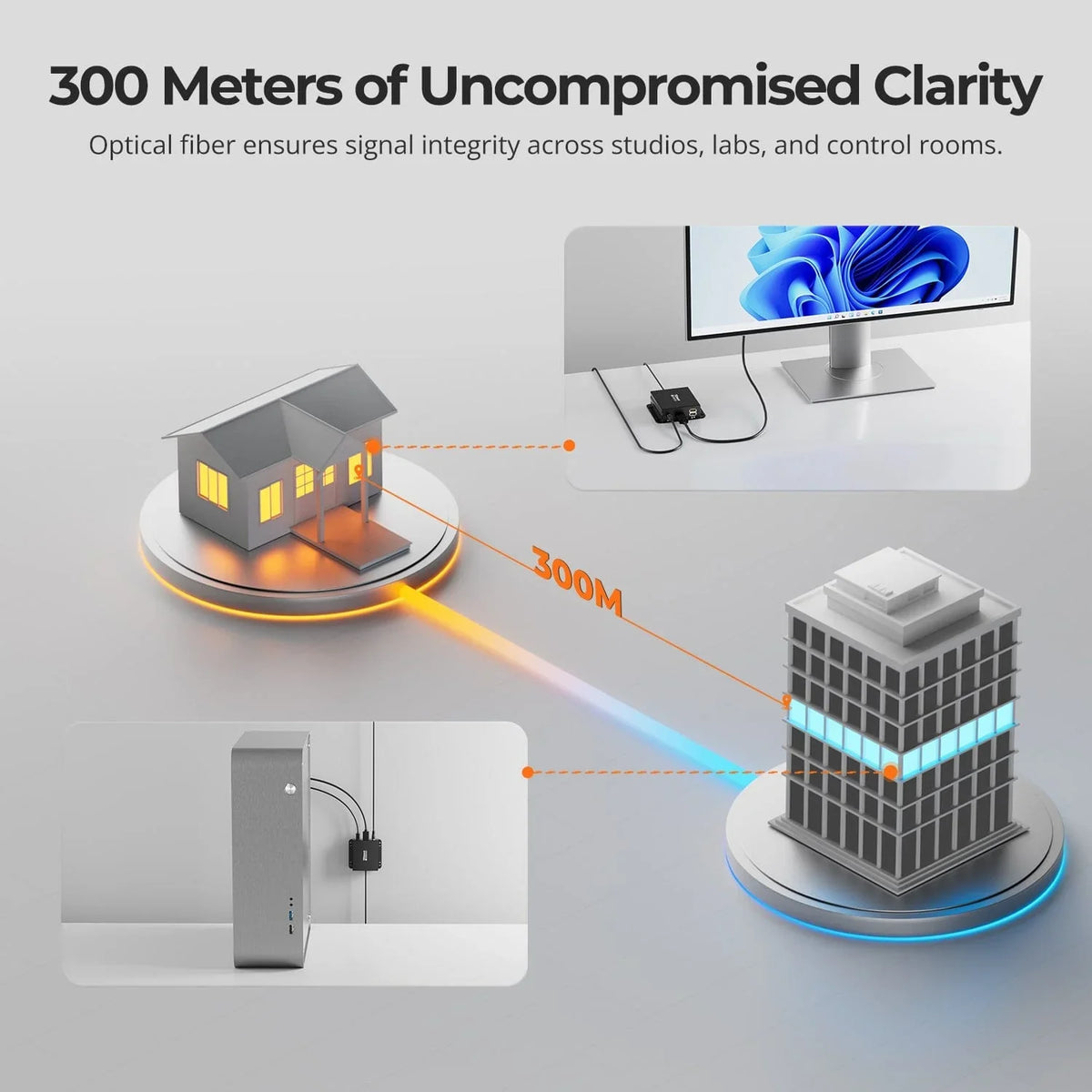
Performance note: At a wavelength of 850 nm with OM4 fiber, the maximum transmission distance of the DKE30SS-M25 is 300 meters.. The actual range can be affected by the number of connectors, the fiber quality, and the overall loss of the connection.
Understanding “LC-LC OM4”
LC-LC: Connector type
LC (Lucent Connector) is a small form factor connector commonly used with SFP, SFP+ and SFP28 modules.
Features: 1.25 mm ferrule, locking mechanism, high port density.
"LC-LC" means LC connectors on both ends, ensuring direct compatibility with DKE30SS-M25 ports.
Important: LC only indicates the connector type; it does not say whether the fiber is single-mode or multi-mode.

OM4: Multimode fiber standard
OM4 is a high-bandwidth multimode fiber standard optimized for short-range high-speed connections.
| Characteristic | OM4 multimode fiber |
|---|---|
| Core/Mantle | 50/125 µm |
| Optimized wavelength | 850 nm |
| bandwidth | ≥ 4700 MHz·km |
| Jacket color | Aqua& |
| Typical use | 10G/25G/40G/100G short-range connections |
OM4 ensures stable communication for SR-class optical modules with sufficient system reserves for high-speed data center connections.
Singlemode vs. multimode fiber
A common misconception is that single-mode fibers are "better". The truth is:
| Characteristic | Singlemode (OS2) | Multimode (OM4) |
|---|---|---|
| Core diameter | 9/125 µm | 50/125 µm |
| Optimized wavelength | 1310/1550 nm | 850 nm |
| Typical use | Long-haul, carrier networks | Short-haul, data center |
| Cost & energy | Higher | Lower, more efficient for short distances |
Single-mode fibers are suitable for long-distance transmissions, while in short-distance data center environments Multimode OM4 is the optimal choice is.
FAQ: Common mistakes when selecting fibers for DKE30SS-M25
Q1: Can LC-LC OS2 single-mode fiber be used instead of OM4?
No. The DKE30SS-M25 uses multimode SR modules at 850 nm. Singlemode OS2 has a smaller core and the wrong wavelength – the connection will fail, even if the connectors fit.
Q2: Can single-mode fiber be used via FC-LC patch cables or adapters?
No. Adapters only change the plug type. They do not convert single-mode fiber into multi-mode fiber.. A physical connection is not enough – no signal, no communication.
Q3: Can SC-LC or FC-LC cables be used instead of LC-LC?
Not recommended. DKE30SS-M25 ports are LC. Adapters add ~0.2–0.5 dB loss and can cause reflections, which can be problematic for high-speed connections.
Q4: Can OM3 fiber be used instead of OM4?
OM3 works well at very short distances, but OM4 offers:
- Higher bandwidth reserve
- Improved tolerance to aging and loss
- More stable high-speed connections
F5: If the connector fits, is the fiber correct?
No. A physical connection does not guarantee optical compatibility. A connection will only work if:
- Optical modules are identical (SR Multimode vs. LR Singlemode)
- Fiber types match (OM4 vs. OS2)
- Connector type and end surface quality are correct
How to identify the right fiber
Check before installation:
- Cable marking: OM4 50/125 LC-LC
- Jacket color: Aqua
- Connector type: LC at both ends
- Fiber type: Multimode
installation & Maintenance tips:
- Minimum bending radius: Avoid tight bends. Normally ≥ 10× cable diameter.
- Dust protection: Attach dust caps to unused plugs.
Avoid cables labelled as OS2, Singlemode, SC, FC or "Universal Fiber".
Quick checklist for troubleshooting
- Check cables: Is the jacket aqua? Is it marked OM4 50/125?
- Check the connector: LC at both ends? Are the end surfaces clean and dust-free? (Inspect with a fiber microscope if necessary)
- Check device: Is the optical module on the counterpart multimode SR? No mixing with single mode.
- Simplify the test: Connect directly with a new LC-LC OM4 cable to eliminate existing cables/adapters.
- Check distance: Total length ≤ 300 m maximum distance.
Official fiber recommendation
For optimal performance, use:
LC-LC OM4 multimode fiber optic cable (50/125 µm)
Other fiber types may lead to connection problems or unstable communication despite a physical connection.
conclusion
The DKE30SS-M25 is designed for high-speed multimode transmissions over short distances (up to 300 m). Selecting the right fiber is crucial for reliable communication and preventing outages.
Note: Physical connection ≠ optical compatibility. Choose the correct fiber from the start and follow the installation guidelines.

Split:
Build an efficient and immersive home office with the TESmart HDC202-X24 Thunderbolt 4 KVM Switch
Upgrading Mac storage made easy: Save costs and maximize performance with an 8TB Thunderbolt SSD